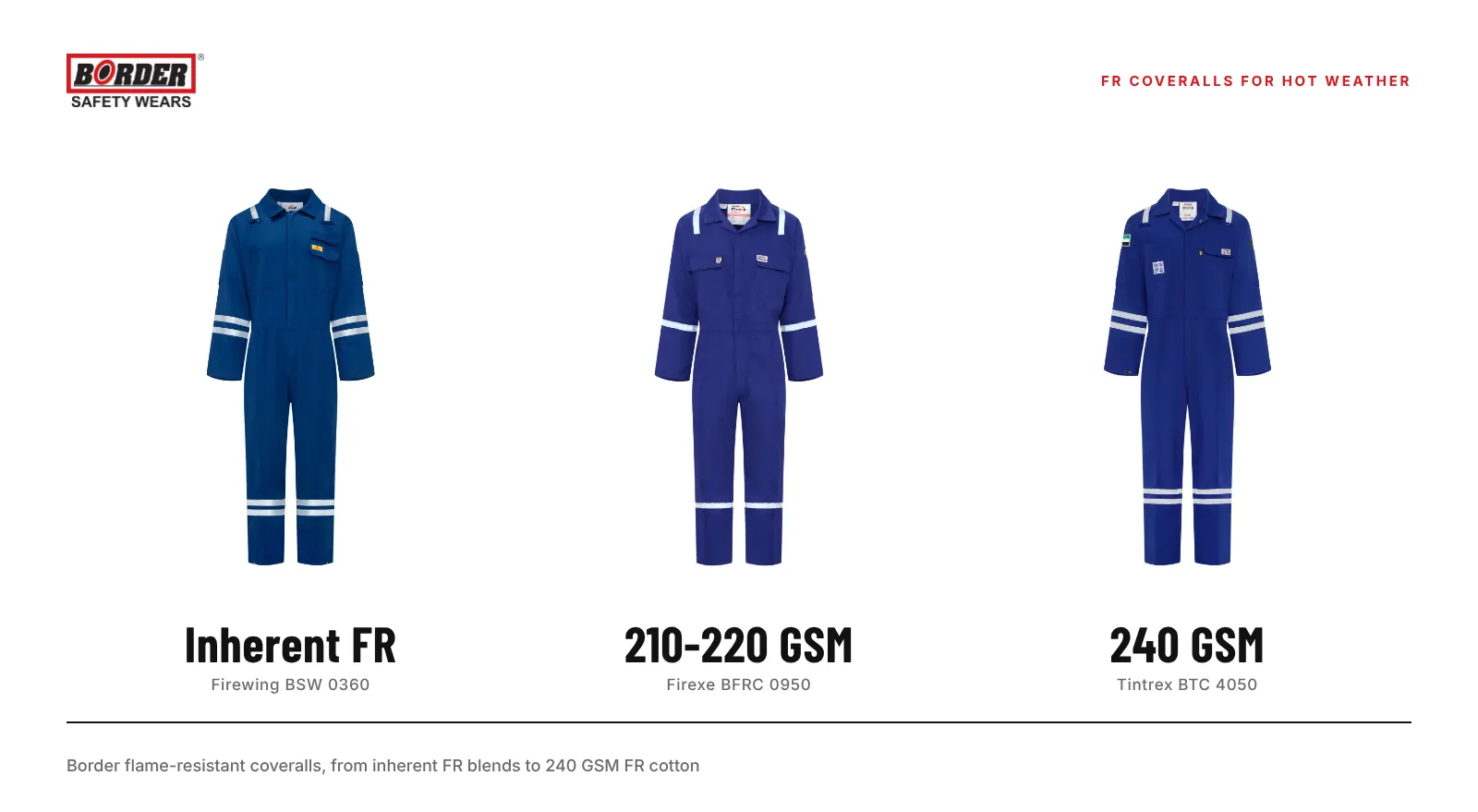
Every summer, the same problem comes back on Gulf and African sites. The specification says FR coveralls, the crews say they are too hot, and by noon half of them are unzipped to the waist with sleeves rolled up. At that point the coverall is not doing its job. The better answer is a coverall that meets the standard and is light enough that people keep it on.
This guide covers what actually makes an FR coverall cooler, and what you must not give up to get there.
Start with the protection you need
Lighter fabric usually means a lower level of protection, so first check what your site requires. Most specifications ask for EN ISO 11612, which grades a garment with letter codes:
| Code | What it tests |
|---|---|
| A1 / A2 | Limited flame spread (A1 surface ignition, A2 edge ignition) |
| B1 to B3 | Convective heat (flames) |
| C1 to C4 | Radiant heat |
| D1 to D3 | Molten aluminium splash |
| E1 to E3 | Molten iron splash |
| F1 to F3 | Contact heat |
For general plant work in oil, gas and petrochemicals, A1, B1 and C1 are the usual minimum, and many specs add EN 1149-5 (antistatic) and NFPA 2112 (flash fire). Foundry and furnace work needs D or E levels, which a lightweight coverall will not give you. If your spec names higher levels, a lighter garment is not an option, and the answer to heat is shift planning, not fabric.
Fabric weight: the first thing to compare
Fabric weight is given in grams per square metre (GSM). For FR cotton, heavier weights of 260 to 300 GSM are hard-wearing but hot. Around 200 to 220 GSM is noticeably lighter and is still widely used for plant work. Some inherent FR blends go lower again.
| Coverall | Fabric and weight | EN ISO 11612 in product data |
|---|---|---|
| BSW Firewing BSW 0360 | Inherent FR modacrylic and cotton blend with antistatic fibre | A1, A2, B1, C1, F1, plus EN 1149-5 |
| TopSafe Noburn TFRC 2000 | 100% cotton FR, 200 to 220 GSM | Listed, with EN ISO 11611 |
| Firexe BFRC 0950 | 100% cotton FR, 210 to 220 GSM | Listed, with EN ISO 11611 |
| Tintrex BTC 4050 | 98% FR cotton, 2% antistatic, 240 GSM | A1, A2, B1, C1, F1, plus EN 1149-5, NFPA 2112 |
Check the datasheet for each garment before you order; the codes on it are what your HSE team will look for.
Inherent FR or treated FR cotton
Treated FR cotton is cotton with a flame-retardant finish. It is comfortable, absorbs sweat and is usually the lower-cost option. Inherent FR fabrics, such as modacrylic blends, are flame resistant because of the fibre itself, so the protection does not wash out. Inherent blends can be lighter for the same protection, which is why they are popular for hot climates. Our article on inherent FR versus treated FR goes into this in more detail.
Whichever you choose, follow the washing instructions on the label. Treated FR garments in particular should not be washed with bleach or fabric softener, which can affect the finish.
Colour, fit and design
- Colour: lighter colours absorb less sunlight. Where your company colour allows it, a light blue or khaki is cooler outdoors than navy or black.
- Fit: a slightly loose fit lets air move and leaves an insulating gap between fabric and skin. A coverall that is too tight is hotter and gives less protection. Order the right size for each worker rather than one size for all.
- Two-piece or one-piece: some crews find a FR shirt and trouser suit cooler and easier to manage than a coverall. Both can meet the same standard; check your site rules.
What not to do
- Do not wear synthetic layers underneath. Polyester T-shirts and sports base layers can melt onto skin in a flash fire. Wear cotton or an FR base layer underneath.
- Do not roll up sleeves or open the coverall. The protection only works where the fabric covers the body.
- Do not cut sleeves or add vents yourself. Any change to the garment voids its certification.
Heat stress is a planning problem too
Even the lightest compliant coverall adds heat. In the UAE, the midday break for outdoor work runs through the summer months, and most GCC countries have similar rules. Plan heavy work for early morning, give crews shade and cool water, and train supervisors to spot heat illness. Our heat illness guide lists the warning signs.
Ordering
Send us your specification and we will match a coverall to it, lighter where the standard allows. Coveralls can carry your logo and company colour. See the full coverall range, or read our oil and gas PPE page for the rest of the kit.