Contractor specifications in the UAE and the wider GCC usually ask for safety helmets to EN 397, the European standard, and sometimes to ANSI/ISEA Z89.1, the American one. Many helmets carry both. The two standards test different things, so it helps to know what each marking means before you sign off a submittal.
EN 397: industrial safety helmets
EN 397 is the European standard for industrial safety helmets. Its compulsory tests cover the risks of a typical building site or plant:
- Shock absorption: a 5 kg striker is dropped from 1 metre onto the crown. The force passed to the head form must not exceed 5 kN.
- Penetration: a 3 kg pointed striker is dropped from 1 metre and must not touch the head form.
- Flame resistance: the shell must stop burning within 5 seconds of a flame being removed.
- Chin strap anchorage: if fitted, the strap must release between 150 and 250 N, so it does not strangle the wearer if the helmet is caught.
EN 397 also has optional requirements. If a helmet passes them, it is marked accordingly:
| Marking | Meaning |
|---|---|
| -20 °C or -30 °C | Very low temperature |
| +150 °C | Very high temperature |
| 440 V a.c. | Electrical insulation (short, accidental contact) |
| LD | Lateral deformation |
| MM | Molten metal splash |
If a marking is not on the helmet, it has not been tested for that property. Do not assume it.
ANSI/ISEA Z89.1: types and classes
The American standard sorts helmets by the direction of impact they are tested for (Type) and by electrical performance (Class):
| Rating | Meaning |
|---|---|
| Type I | Reduces the force of impact to the top of the head |
| Type II | Reduces the force of impact to the top and the sides |
| Class G (General) | Tested at 2,200 volts |
| Class E (Electrical) | Tested at 20,000 volts |
| Class C (Conductive) | No electrical protection |
The class voltages are test values, not safe working voltages. For live electrical work, follow your electrical safety rules; Europe has a separate standard, EN 50365, for electrically insulating helmets.
EN 397 or ANSI: which should you ask for?
Ask for the standard your client or consultant names. If you are writing the specification, EN 397 is the common baseline in the Gulf and Africa. A helmet that carries both gives you more flexibility when the same stock goes to different projects. For work at height where the helmet must stay on in a fall, look for a chin strap; climbing-style helmets to EN 12492 are designed for that.
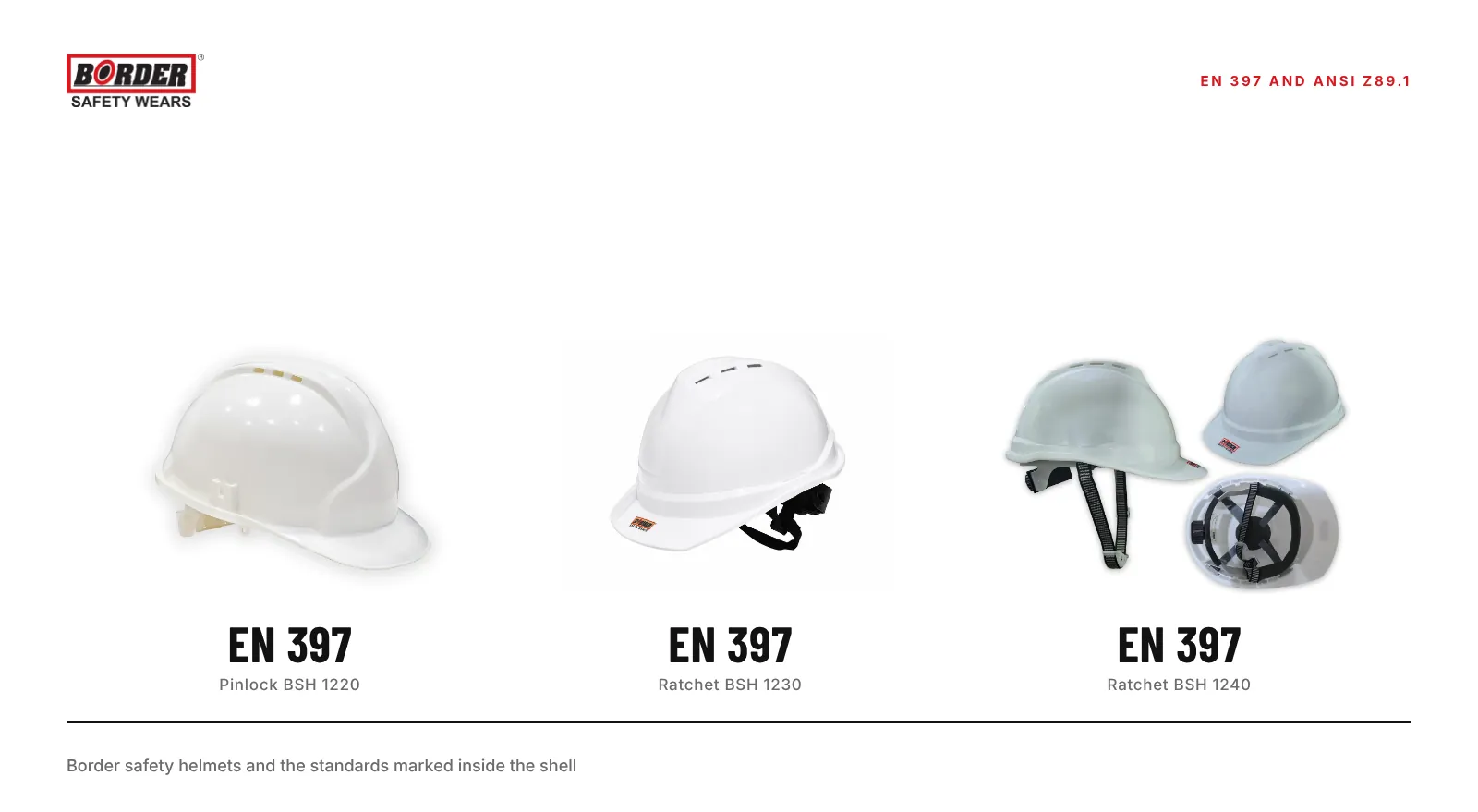
Our helmets list the standards on their datasheets:
- BSH 1220: HDPE shell, pinlock adjustment, EN 397 and ANSI/ISEA Z89.1-2014, seven colours.
- BSH 1230: ABS shell, 4-point ratchet suspension, EN 397:2012+A1:2012.
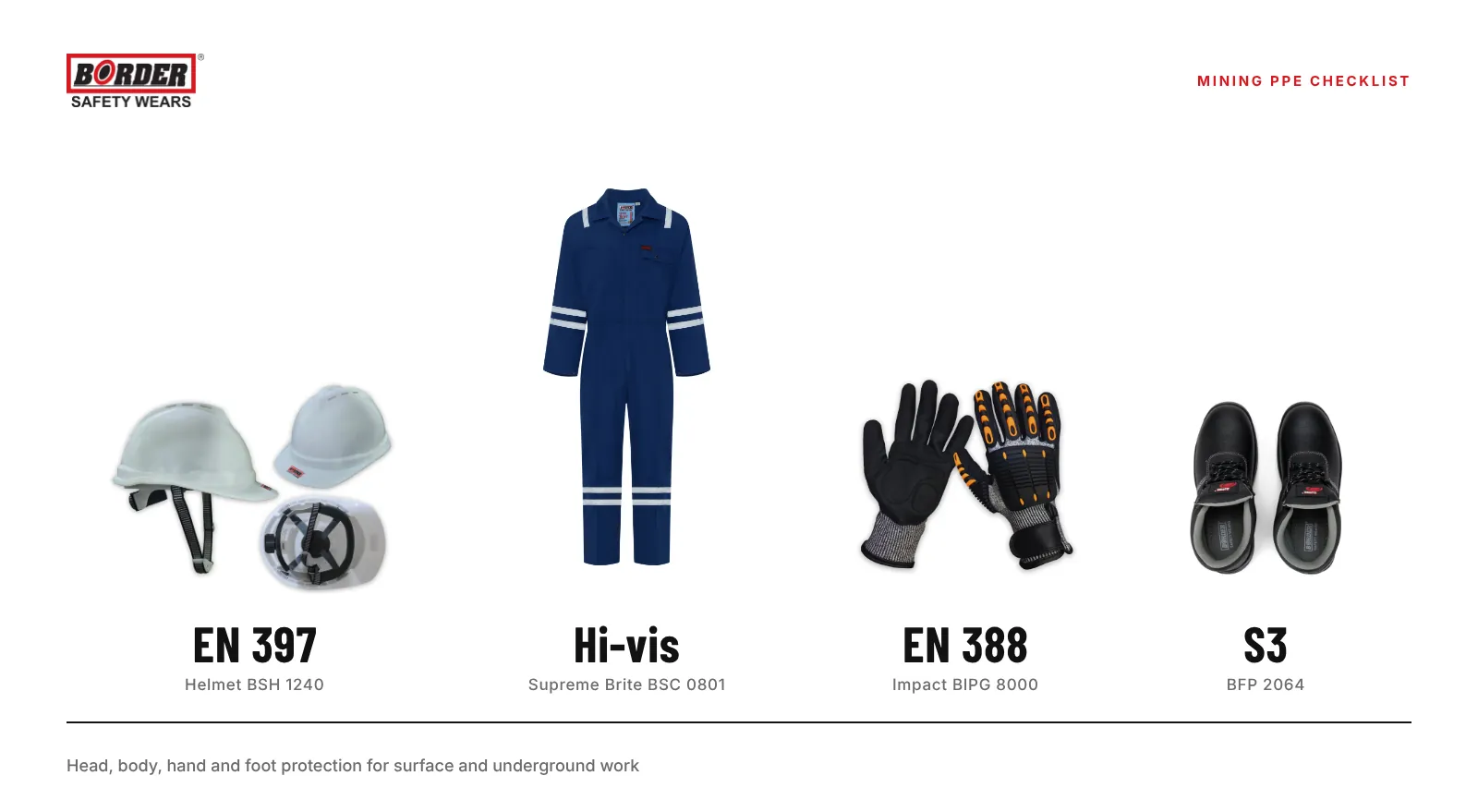
- BSH 1240: HDPE shell, ratchet and vents, 360 g, EN 397 and ANSI/ISEA Z89.1-2014.
Reading the markings inside the shell
Look under the brim or inside the crown. You should find the standard number, the manufacturer, the model, the size range and the date of manufacture, usually as a small moulded clock or the year and quarter. Any optional EN 397 markings appear here too. If the date or the standard is missing, do not accept the helmet.
How long does a helmet last?
There is no single expiry date in EN 397. Manufacturers give a service life for their shells, often a few years from first use for thermoplastics such as HDPE and ABS, and less for helmets left in strong sun. In the Gulf, UV and heat age a shell faster than in Europe, so do not leave helmets on dashboards or in open site stores.
Replace a helmet straight away if:
- it has taken a significant blow, even if no damage is visible;
- the shell is cracked, dented, chalky or faded;
- the harness is torn or the ratchet no longer holds;
- it has been painted, drilled or covered in stickers with strong solvents.
Harnesses and sweatbands can usually be replaced separately; check with the supplier.
Colours
Colour has no meaning in EN 397 or ANSI. Colour codes are set by the site or the company. Our hard hat colour code guide shows the scheme most UAE sites use.
Browse all safety helmets, or see the construction PPE page for a full site kit.