Ask for "a dust mask" and you can get anything from a paper nuisance mask to an FFP3 respirator. The letters on the mask tell you how much protection it gives, under which standard. Here is how the common ratings compare, and how to choose between them on site.
Three standards, one job
FFP, N95 and KN95 masks are all filtering facepieces: disposable masks that filter particles such as dust, mist and fume. They are tested under different national standards:
| Rating | Standard | Minimum filter efficiency |
|---|---|---|
| FFP1 | EN 149 (Europe) | 80% |
| FFP2 | EN 149 (Europe) | 94% |
| FFP3 | EN 149 (Europe) | 99% |
| N95 | NIOSH 42 CFR 84 (USA) | 95% |
| KN95 | GB 2626 (China) | 95% |
EN 149 also limits total inward leakage, which includes air that gets in around the edges: no more than 8% for FFP2 and 2% for FFP3. In practice, FFP2, N95 and KN95 are treated as broadly comparable, and FFP3 is a step above.
Reading the other markings
- NR or R (EN 149): NR means non-reusable, for one shift only. R means it can be reused if the manufacturer's instructions allow.
- D (EN 149): the mask passed the dolomite dust clogging test, so it stays comfortable to breathe through longer in heavy dust.
- N, R, P (NIOSH): N is not resistant to oil mist; R is somewhat resistant; P is oil proof. 95, 99 and 100 give the efficiency.
- Exhalation valve: makes breathing out easier and reduces heat build-up. It does not change the filter class.
A genuine N95 carries the NIOSH approval marking and a TC approval number, and a KN95 carries the GB 2626 standard number. Counterfeit masks are common, so buy from a supplier who can show the test report.
Which mask for which job
| Job | Typical choice |
|---|---|
| Sweeping, general site dust, sandstorms | FFP2, N95 or KN95 |
| Cutting concrete, block or stone (silica) | FFP3, with water suppression or extraction on the tool |
| Sanding, grinding, plastering | FFP2 or FFP3 depending on the material |
| Welding fume in a ventilated area | FFP2 or FFP3, as part of an extraction plan |
| Grit blasting | Not a disposable mask: an air-fed blasting helmet |
| Paint spraying, solvents, chemicals | Not a disposable mask: a half or full mask with gas and vapour filters |
Respirable crystalline silica from cutting concrete and stone causes silicosis, an incurable lung disease. Treat it seriously: control the dust at the tool first, then choose the mask.
What a particle mask does not protect against
FFP, N95 and KN95 masks filter particles. They do nothing against gases and vapours such as solvents, ammonia, chlorine or hydrogen sulphide. For those you need a half or full face mask with the right gas filter (the EN 14387 types A, B, E and K, colour-coded brown, grey, yellow and green), or supplied air. Your HSE team should choose the filter for the specific chemical. No mask helps in an oxygen-deficient space such as a tank or pit; that needs breathing apparatus and a confined space procedure.
Fit is half the protection
- A mask only works if it seals against the face. Facial hair under the seal lets dust in.
- Shape the nose clip with both hands, and check the seal by breathing in sharply: the mask should pull in slightly.
- For FFP3 and for regular use, a fit test with the specific model is good practice and required on many sites.
- Replace the mask when it is damaged, wet, dirty inside or hard to breathe through.
From our range
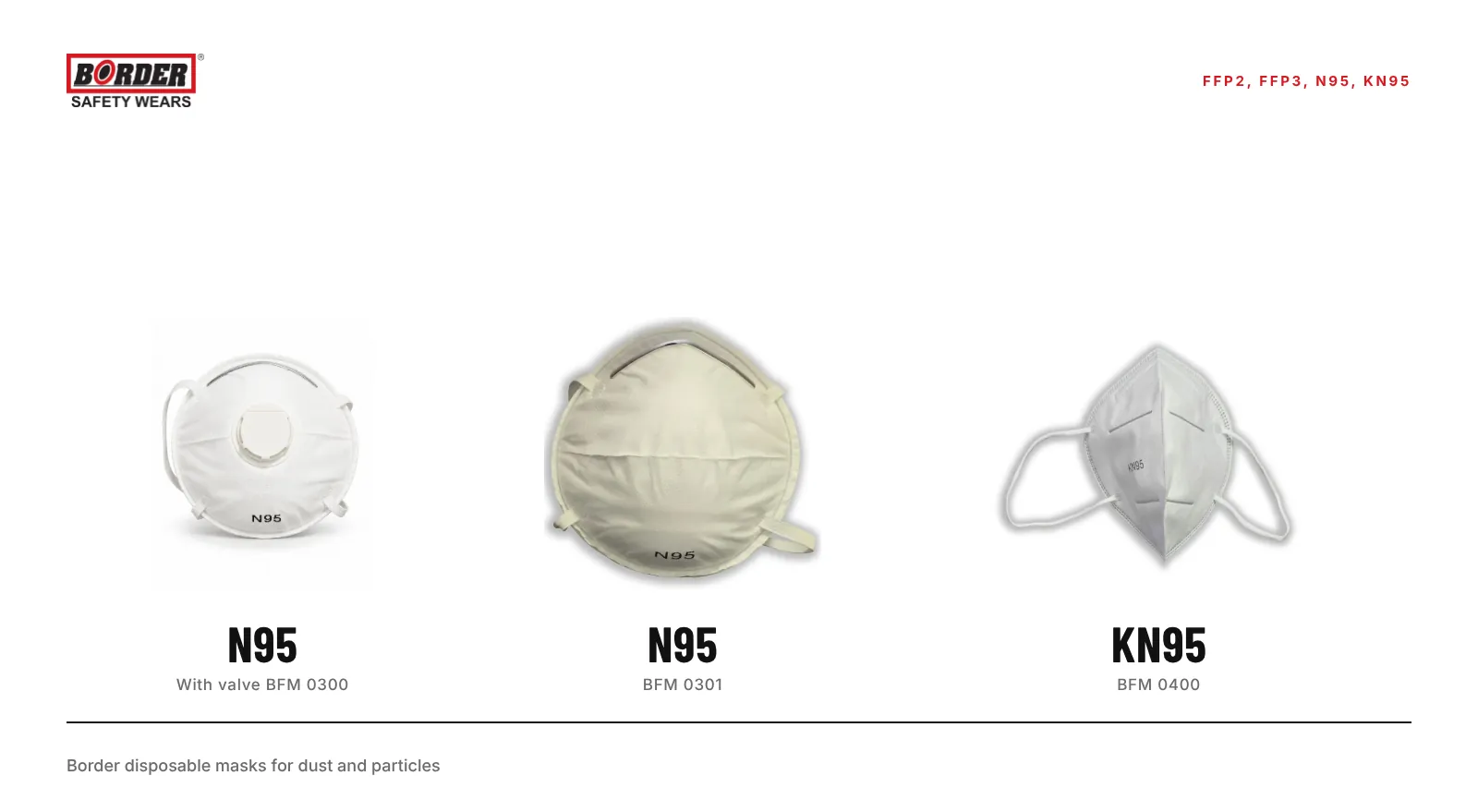
- N95 Safety Mask with valve BFM 0300: cup-shaped, with exhalation valve for hot and heavy work.
- N95 Safety Mask without valve BFM 0301.
- KN95 Safety Mask BFM 0400: fold-flat, easy to carry.
Datasheets are on each product page. For more on choosing respirators on UAE sites, read our earlier article on respirator safety, and for dust storms, the sandstorm PPE guide. All masks are in safety masks.