Most PPE advice for the Gulf is about heat, and for good reason. But from December to February, crews on desert sites, pipelines, road projects and plants work night shifts in temperatures that drop a long way below the daytime figure. Inland deserts in the UAE, Oman and Kuwait can fall into single figures at night, and in central and northern Saudi Arabia temperatures can approach freezing. Add damp air and fog, and a crew in summer kit gets cold quickly.
Why cold matters on site
Cold hands lose grip and feeling. Cold workers move more slowly, make more mistakes and are more likely to take shortcuts such as working with their hands in their pockets or skipping gloves. Many of these workers spend the rest of the year in extreme heat and are not used to cold, so they feel it more.
Layer, do not bulk up
Several thinner layers keep a worker warmer than one thick one, and layers can be removed as the night warms up or work gets heavier:
- Base layer: cotton next to the skin. Avoid synthetic base layers if the job involves any flame or hot work.
- Work layer: the normal coverall or work suit.
- Outer layer: a winter jacket, ideally with reflective tape and a hood that fits over or under the helmet.
Winter jackets
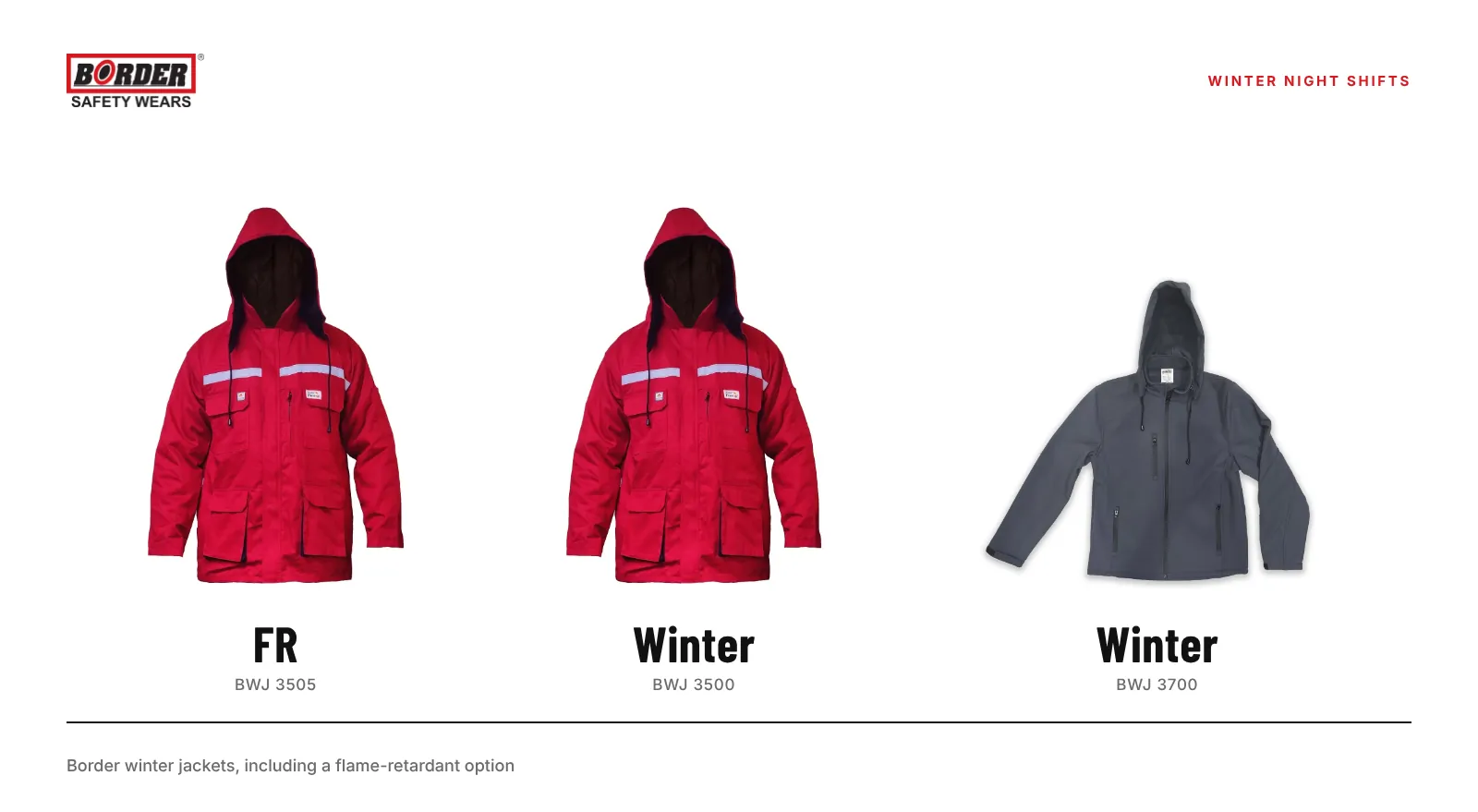
- Winter Jacket BWJ 3500: red hooded jacket with reflective tape and front pockets.
- Winter Jacket BWJ 3700: dark grey hooded jacket with zip front.
- FR Winter Jacket BWJ 3505: for plants and hot work, made from 100% cotton FR fabric, listing EN ISO 11612, EN ISO 11611 and EN ISO 20471.
The FR rule in winter
On sites where FR clothing is required, the outer layer must be FR too. A regular polyester winter jacket worn over an FR coverall can ignite or melt and defeat the coverall underneath. If your crew needs a jacket at an oil, gas or petrochemical site, choose an FR jacket such as the BWJ 3505, and keep synthetic fleeces and thermals out of hot work areas. See our oil and gas PPE page for the full FR kit.
Hands
Thin coated gloves that are fine in summer are cold at 3 a.m. Heavier knitted cotton gloves, such as the BKG 2403 800 gm, add warmth for light work, and leather rigger gloves keep wind off the hands for handling. Choose the glove for the task first; warmth is a bonus, not a replacement for cut or impact protection.
Visibility at night and in fog
Winter brings long nights and, on the UAE coast and inland, thick morning fog. Visibility clothing matters more than at any other time of year:
- Use garments with plenty of retroreflective tape, on the jacket as well as the vest. A vest worn under a jacket does nothing.
- Near traffic at night, Class 3 clothing is the safer choice. Our hi-vis class guide explains why.
- Mark work zones with solar barricade lights, LED traffic batons for banksmen, and reflective cones.
Feet
Night dew and winter rain leave sites wet. S3 shoes, which add a water-resistant upper to S1P protection, keep feet drier, such as the BFP 2064. Wet socks are the fastest way to get cold; a spare pair in the site cabin helps.
Head and breathing
Much body heat is lost through the head. A hood worn under the helmet, or a helmet liner, keeps workers warm without removing head protection. Winter is also the season of the shamal wind in parts of the Gulf, which brings dust; keep dust masks and sealed goggles available. Our sandstorm guide has more.
Plan the order before the cold arrives
Winter jacket orders tend to come in all at once in December. Order sizes per crew in November, and keep a few spares on site for new joiners. For seasonal planning across the year, see our seasonal PPE guide. All jackets are in safety vests and winter jackets.


