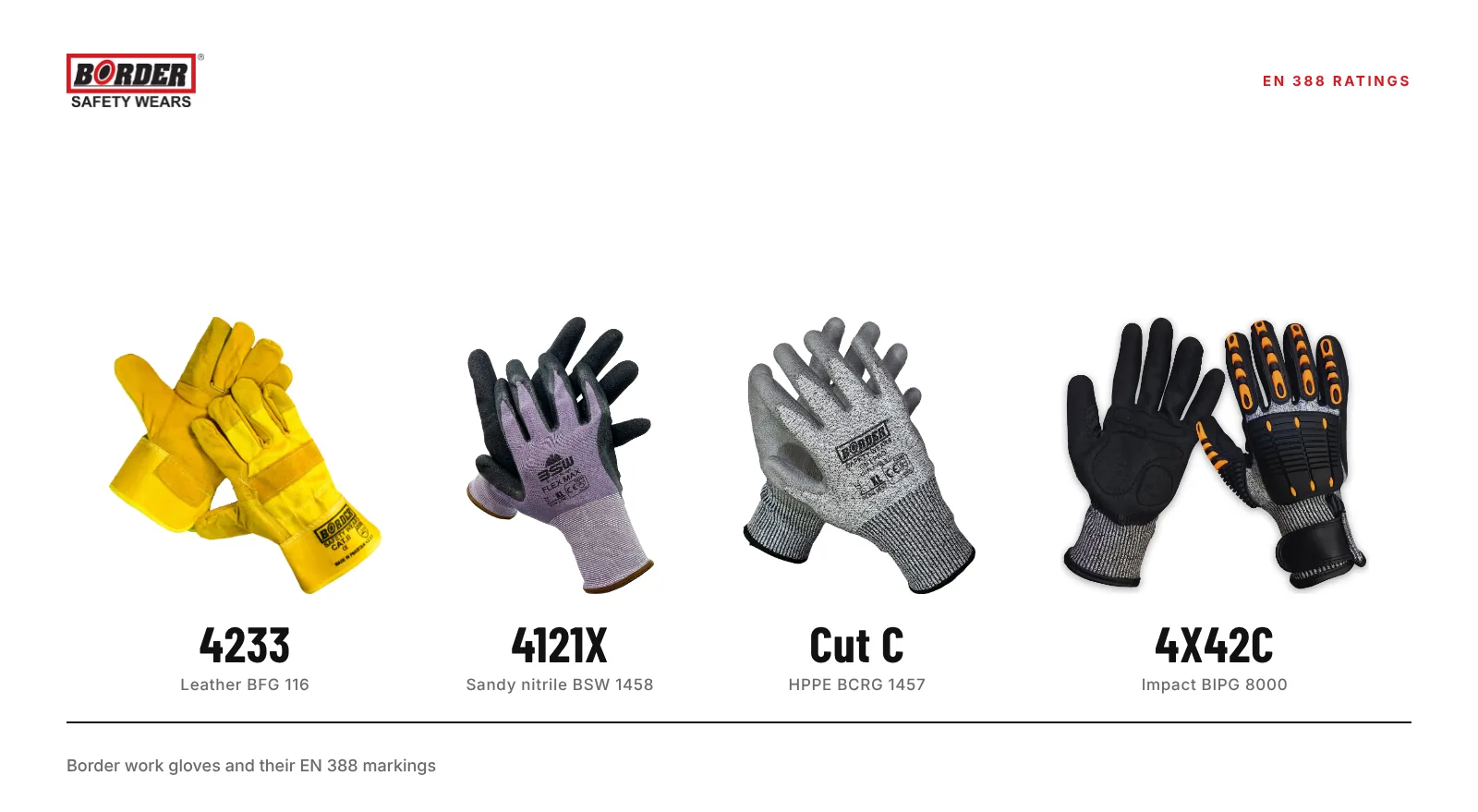
Turn over almost any work glove and you will find a shield symbol with a hammer, and under it a short code such as 4121X or 4X42C. That is the EN 388 rating. It is the quickest way to compare two gloves that look the same but protect very differently.
EN 388 covers mechanical risks only: abrasion, cuts, tears, punctures and, optionally, impact. It says nothing about chemicals, heat or electricity, which have their own standards.
How to read the code
The current version is EN 388:2016 (amended in 2018). Its code has up to six characters, always in this order:
| Position | Test | Scale |
|---|---|---|
| 1st digit | Abrasion resistance | 0 to 4 |
| 2nd digit | Cut resistance, coup test | 0 to 5, or X |
| 3rd digit | Tear resistance | 0 to 4 |
| 4th digit | Puncture resistance | 0 to 4 |
| 5th, letter | Cut resistance, ISO 13997 (TDM) test | A to F, or X |
| 6th, letter P | Impact protection (knuckles and back of hand) | P if passed, otherwise left off |
Higher is better on every scale. A 0 means the glove was tested and fell below level 1. An X means the test was not carried out or does not apply to that glove.
What each level means in the lab
| Level | Abrasion (cycles) | Tear (newtons) | Puncture (newtons) |
|---|---|---|---|
| 1 | 100 | 10 | 20 |
| 2 | 500 | 25 | 60 |
| 3 | 2,000 | 50 | 100 |
| 4 | 8,000 | 75 | 150 |
The cut scale: why there are two cut tests
The older coup test runs a rotating circular blade back and forth over the material. It works well for cotton and polyester, but tough fibres such as glass and HPPE blunt the blade and give misleading results. So the 2016 version added the ISO 13997 (TDM) test, which measures the force in newtons a straight blade needs to cut through.
| TDM letter | Force needed to cut | Typical use |
|---|---|---|
| A | 2 N or more | General handling, low cut risk |
| B | 5 N or more | Light assembly, packaging |
| C | 10 N or more | Sheet metal, glass, rebar handling |
| D | 15 N or more | Sharp metal edges, cutting operations |
| E | 22 N or more | Heavy metal fabrication, glazing |
| F | 30 N or more | Very sharp blades and high cut risk |
When a glove has a TDM letter, that letter is the cut rating to compare. If the coup result shows X, it is because the material blunted the blade and the TDM test was used instead.
American datasheets use a different scale, ANSI/ISEA 105, with cut levels A1 to A9. The two scales are not the same, so compare like with like.
Reading real gloves
- Leather glove BFG 116, rated 4233: top abrasion, cut level 2, tear 3, puncture 3. A good all-round rigging and material handling glove.
- Sandy nitrile glove BSW 1458, rated 4121X: top abrasion with a sandy nitrile grip for oily parts; low cut resistance; TDM not tested.
- Fully nitrile coated TNG 6004, rated 3111X: the full coating keeps oil and water out; it is a grip glove, not a cut glove.
- Cut resistant glove BCRG 1457: HPPE shell with PU palm, abrasion 4 and cut level C. For sheet metal, glass and rebar.
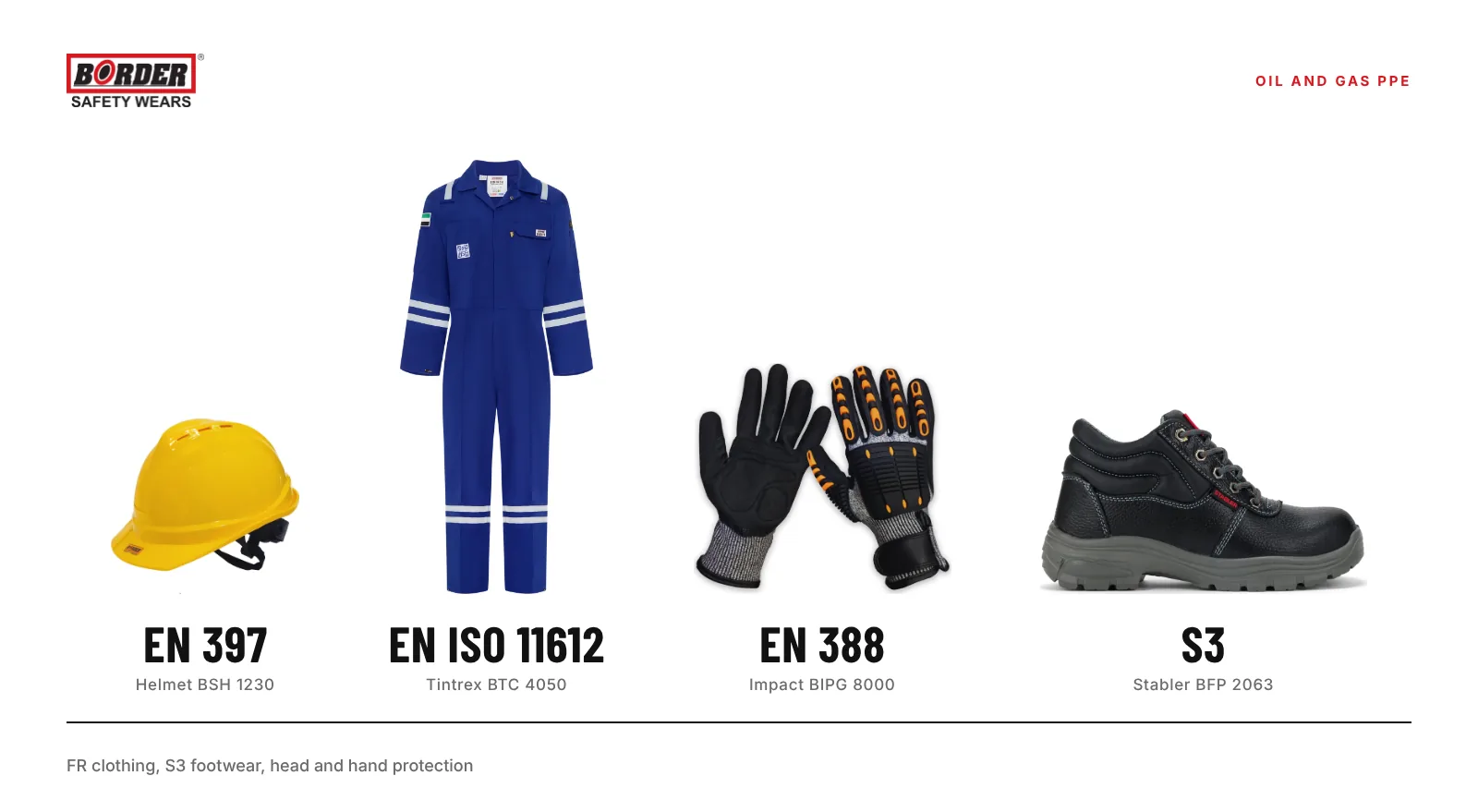
- Impact glove BIPG 8000, rated 4X42C: top abrasion, coup cut X, tear 4, puncture 2 and cut level C, with TPR guards on the back of the hand. Its datasheet also lists ANSI cut level A3. Used on drilling floors and in heavy lifting.
Choosing by job
| Job | Look for |
|---|---|
| General handling, warehouse | Abrasion 3 or 4, coated palm for grip |
| Rebar, sheet metal, glass | Cut level C or higher |
| Oily parts, mechanical work | Nitrile coating, abrasion 4 |
| Rigging, drilling, pipe handling | Impact guards on the back of the hand, cut level C |
| Welding | EN 12477 welding gloves; EN 388 alone is not enough |
| Chemicals | EN ISO 374 chemical gloves; EN 388 says nothing about chemicals |
A word on comfort in the Gulf
A glove that is too hot gets taken off. In summer, thin knitted shells with a palm coating (13 or 15 gauge) are cooler than full leather or fully coated gloves. Keep the heavy gloves for the tasks that need them, and give crews a lighter glove for everything else.
Browse the full range of safety gloves, or send us the task and quantity and we will suggest the right rating with datasheets. For a full kit, see our construction PPE checklist.