Every safety shoe sold to EN ISO 20345 carries a short code such as S1P or S3. The code tells you which protections the shoe has passed in the lab. Buy the wrong one and you either pay for protection the job does not need, or send a worker onto a wet site in a shoe that lets water in.
Most buyers in the UAE and the wider GCC end up choosing between two ratings: S1P and S3. Here is what each code means, what changed in 2022, and how to pick.
The ratings at a glance
| Rating | What it has | Typical use |
|---|---|---|
| SB | 200 J toe cap and the basic requirements of the standard | Rarely specified on its own |
| S1 | SB plus closed heel, antistatic and energy absorption in the heel | Dry indoor work with no nail risk |
| S1P | S1 plus a puncture-resistant midsole | Warehouses, FM, fit-out, most dry construction work |
| S2 | S1 plus an upper that resists water penetration | Damp indoor areas, kitchens, cleaning |
| S3 | S2 plus a puncture-resistant midsole and a cleated outsole | Outdoor construction, oil and gas, wet or muddy ground |
| S6 | S2 plus a fully water-resistant shoe (WR) | Work in standing water |
| S7 | S3 plus a fully water-resistant shoe (WR) | Wet outdoor sites with nail risk |
Each step builds on the one before. An S3 shoe has everything an S1P has, plus water resistance in the upper and a cleated sole.
What changed in EN ISO 20345:2022
The standard was revised in 2022. Shoes certified to the 2011 version are still on the market, so you will see both on datasheets. The main differences buyers notice:
- Slip ratings. The old SRA, SRB and SRC markings are gone. Every shoe must now pass a basic slip test on tiles with a detergent solution. An extra test on tiles with glycerine earns the marking SR.
- Fuel oil resistance. Oil resistance of the outsole is no longer part of S1 to S3. A shoe that has it now carries its own marking, FO. If your site has diesel or oil on the floor, check for FO on the label.
- Puncture resistance. Steel midsoles are marked P. Non-metal (textile or Kevlar) midsoles are now split into PL, tested with a 4.5 mm nail, and PS, tested with a thinner 3 mm nail. So you may see S1PL or S3S on newer shoes.
- New S6 and S7 categories for shoes that are water-resistant as a whole, not just in the upper.
Other markings on the label
After the category you may see extra letters. The common ones:
- HRO: heat-resistant outsole, for hot surfaces such as fresh asphalt or near furnaces.
- SR: passed the extra slip test (2022 version).
- FO: fuel oil resistant outsole (2022 version).
- WR: water-resistant shoe.
- HI and CI: heat and cold insulation of the sole.
- M and AN: metatarsal and ankle protection.
S1P or S3: how to choose
| Site or job | Our usual pick | Why |
|---|---|---|
| Warehouse, logistics, FM technicians | S1P, light composite toe | Dry floors, long hours on foot, comfort matters most |
| Fit-out and indoor construction | S1P | Nails and screws on the floor, little water |
| Outdoor construction and infrastructure | S3 | Wet curing, mud after rain, uneven ground needs the cleated sole |
| Oil and gas, refineries | S3, ideally with FO and SR | Oil, water and wash-down on the floor |
| Hotel and labour camp kitchens | S1P or S2 with good slip resistance | Wet, greasy tiles |
| Road works and asphalt | S3 HRO | Hot surfaces |
One point specific to the Gulf: an S3 shoe has a water-resistant upper, which also makes it warmer. For indoor and dry work in summer, a breathable S1P with a mesh lining is often the better choice, and workers are more likely to keep it on.
Steel or composite toe?
Both must pass the same 200 J impact test, so the protection is the same. Composite toe caps are lighter, do not conduct heat or cold, and set off no metal detectors. Steel caps are slimmer, so the shoe can be less bulky. Pair a composite toe with a Kevlar midsole and the shoe is completely metal-free.
What we stock
Our safety shoes cover every common rating:
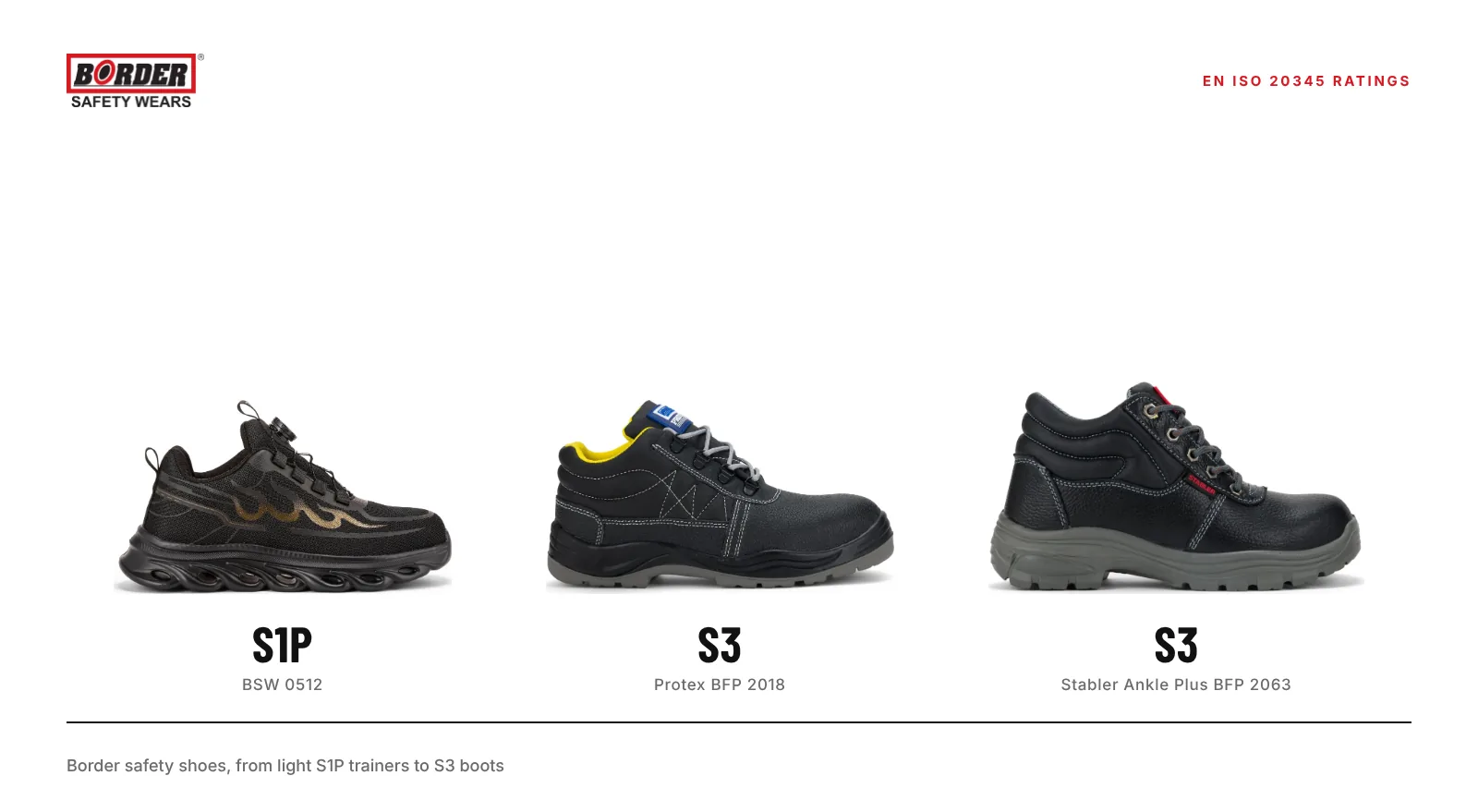
- S1P, light: the BSW 0512 flyknit trainer with composite toe and Kevlar midsole, listed to EN ISO 20345:2022 and ASTM F2413-11.
- S1P, slip-on: the BFP 2020 rigger boot, steel toe and steel midsole, popular on oilfields.
- S1PL: the BFP 2080 slip-on with composite toe and Kevlar midsole, certified to the 2022 version.
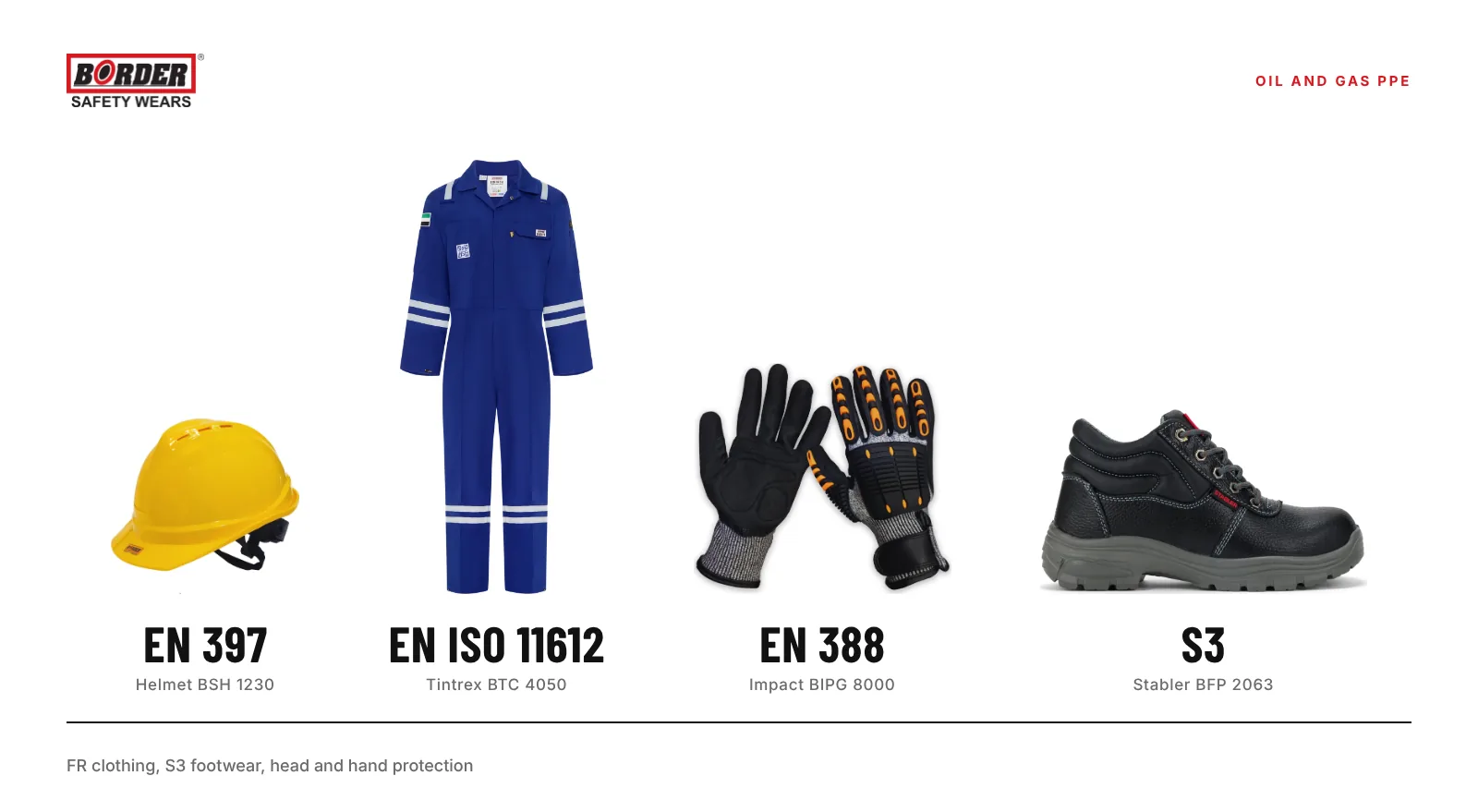
- S3: the Protex BFP 2018 and the Stabler Ankle Plus BFP 2063, both steel toe and steel midsole.
- S3 HRO: the Shielder BFP 2013 for hot surfaces.
- S3, metal-free: the BFP 2035 with composite toe and composite midsole.
Every product page lists the rating and the version of the standard, and you can download the datasheet.
Before you order
- Check which version of the standard your contract or tender names: EN ISO 20345:2011 or 2022.
- Ask for the datasheet and certificate, and check the marking printed inside the tongue matches.
- Order a size split, not a single size. A bulk order in the wrong sizes ends up unused.
- For oil on the floor, look for FO. For tiles, look for SR (or SRC on older shoes).
Send us your list with quantities per size and we will match each line to a shoe and send the quotation with datasheets. You can also read our comparison of safety shoes, gumboots and fire boots.